Diberdayakan oleh Blogger.
Tampilkan postingan dengan label Ekology. Tampilkan semua postingan

The Organization of Ecological Systems

The Organization of Ecological Systems - Ecologists can study ecological relationships at several different levels of organization. The smallest living unit is the individual organism. Groups of organisms of the same species are called populations. Interacting populations of different species are called communities. And an ecosystem consists of all the interacting organisms in an area and their interactions with their abiotic surroundings. shows how these different levels of organization are related to one another.
The Organization of Ecological Systems

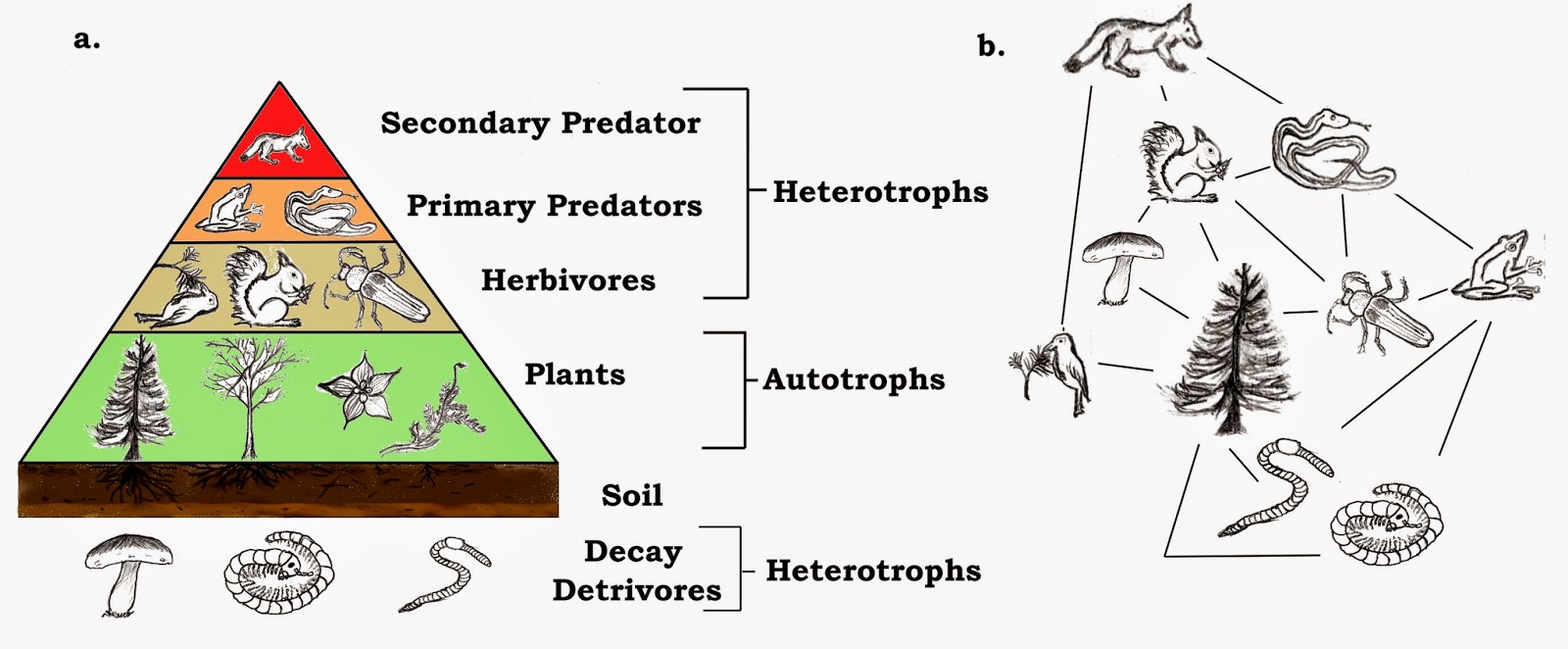
All living things require continuous supplies of energy to maintain life. Therefore, many people like to organize living systems by the energy relationships that exist among the different kinds of organisms present. An ecosystem contains several different kinds of organisms. Those that trap sunlight for photosynthesis, resulting in the production of organic material from inorganic material, are called producers. Green plants and other photosynthetic organisms such as algae and cyanobacteria are, in effect, converting sunlight energy into the energy contained within the chemical bonds of organic compounds. There is a flow of energy from the Sun into the living matter of plants.

The energy that plants trap can be transferred through a number of other organisms in the ecosystem. Because all of these organisms must obtain energy in the form of organic matter, they are called consumers. Consumers cannot capture energy from the Sun as plants do. All animals are consumers. They either eat plants directly or eat other sources of organic matter derived from plants. Each time the energy enters a different organism, it is said to enter a different trophic level, which is a step, or stage, in the flow of energy through an ecosystem. The plants (producers) receive their energy directly from the Sun and are said to occupy the first trophic level.

Various kinds of consumers can be divided into several categories, depending on how they fit into the flow of energy through an ecosystem. Animals that feed directly on plants are called herbivores, or primary consumers, and occupy the second trophic level. Animals that eat other animals are called carnivores, or secondary consumers, and can be subdivided into different trophic levels depending on what animals they eat. Animals that feed on herbivores occupy the third trophic level and are known as primary carnivores.

Animals that feed on the primary carnivores are known as secondary carnivores and occupy the fourth trophic level. For example, a human may eat a fish that ate a frog that ate a spider that ate an insect that consumed plants for food. This sequence of organisms feeding on one another is known as a food chain. Figure 14.4 shows the six different trophic levels in this food chain. Obviously, there can be higher categories, and some organisms don’t fit neatly into this theoretical scheme. Some animals are carnivores at some times and herbivores at others; they are called omnivores.

They are classified into different trophic levels depending on what they happen to be eating at the moment. If an organism dies, the energy contained within the organic compounds of its body is finally released to the environment as heat by organisms that decompose the dead body into carbon dioxide, water, ammonia, and other simple inorganic molecules. Organisms of decay, called decomposers, are things such as bacteria, fungi, and other organisms that use dead organisms as sources of energy.

This group of organisms efficiently converts nonliving organic matter into simple inorganic molecules that can be used by producers in the process of trapping energy. Decomposers are thus very important components of ecosystems that cause materials to be recycled. As long as the Sun supplies the energy, elements are cycled through ecosystems repeatedly. Now that we have a better idea of how ecosystems are organized, we can look more closely at energy flow through ecosystems.

Community, Habitat, and Niche

Community, Habitat, and Niche - People approach the study of organism interactions in two major ways. Many people look at interrelationships from the broad ecosystem point of view; others focus on individual organisms and the specific things that affect them in their daily lives. The first approach involves the study of all the organisms that interact with one another—the community— and usually looks at general relationships among them. 

Another way of looking at interrelationships is to study in detail the ecological relationships of certain species of organisms. Each organism has particular requirements for life and lives where the environment provides what it needs. The environmental requirements of a whale include large expanses of ocean, but with seasonally important feeding areas and protected locations used for giving birth. The kind of place, or part of an ecosystem, occupied by an organism is known as its habitat. Habitats are usually described in terms of conspicuous or particularly significant features in the area where the organism lives. For example, the habitat of a prairie dog is usually described as a grassland and the habitat of a tuna is described as the open ocean. The habitat of the fiddler crab is sandy ocean shores and the habitat of various kinds of cacti is the desert. The key thing to keep in mind when you think of habitat is the place in which a particular kind of organism lives. In our descriptions of the habitats of organisms, we sometimes use the terminology of the major biomes of the world, such as desert, grassland, or savanna, but it is also possible to describe the habitat of the bacterium Escherichia coli as the gut of humans and other mammals, or the habitat of a fungus as a rotting log. Organisms that have very specific places in which they live simply have more restricted habitats.

Each species has particular requirements for life and places specific demands on the habitat in which it lives. The specific functional role of an organism is its niche. Its niche is the way it goes about living its life. Just as the word place is the key to understanding the concept of habitat, the word function is the key to understanding the concept of a niche.

To understand the niche of an organism involves a detailed understanding of the impacts an organism has on its biotic and abiotic surroundings as well as all the factors that affect the organism. For example, the niche of an earthworm includes abiotic items such as soil particle size; soil texture; and the moisture, pH, and temperature of the soil. The earthworm’s niche also includes biotic impacts such as serving as food for birds, moles, and shrews; as bait for anglers; or as a consumer of dead plant organic matter (figure 15.1). In addition, an earthworm serves as a host for a variety of parasites, transports minerals and nutrients from deeper soil layers to the surface, incorporates organic matter into the soil, and creates burrows that allow air and water to penetrate the soil more easily. And this is only a limited sample of all the aspects of its niche.

Some organisms have rather broad niches; others, with very specialized requirements and limited roles to play, have niches that are quite narrow. The opossum is an animal with a very broad niche. It eats a wide variety of plant and animal foods, can adjust to a wide variety of climates, is used as food by many kinds of carnivores (including humans), and produces large numbers of offspring. By contrast, the koala of Australia has a very narrow niche. It can live only in areas of Australia with specific species of Eucalyptus trees because it eats the leaves of only a few kinds of these trees. Furthermore, it cannot tolerate low temperatures and does not produce large numbers of offspring. As you might guess, the opossum is expanding its range, and the koala is endangered in much of its range. The complete description of an organism’s niche involves a very detailed inventory of influences, activities, and impacts. It involves what the organism does and what is done to the organism. Some of the impacts are abiotic, others are biotic. Because the niche of an organism is a complex set of items, it is often easy to overlook important roles played by some organisms.

For example, when Europeans introduced cattle into Australia—a continent where there had previously been no large, hoofed mammals—they did not think about the impact of cow manure or the significance of a group of beetles called dung beetles. These beetles rapidly colonize fresh dung and cause it to be broken down. No such beetles existed in Australia; therefore, in areas where cattle were raised, a significant amount of land became covered with accumulated cow dung. This reduced the area where grass could grow and reduced productivity. The problem was eventually solved by the importation of several species of dung beetles from Africa, where large, hoofed mammals are common. The dung beetles made use of what the cattle did not digest, returning it to a form that plants could more easily recycle into plant biomass.

Population and Species

Population and Species -To understand the principles of genetics in chapter 10, we concerned ourselves with small numbers of organisms having specific genotypes. When these organisms reproduced, we could predict the probability of an allele being passed to the next generation. Plants, animals, and other kinds of organisms, however, don’t exist as isolated individuals but as members of populations. Since populations typically consist of large numbers of individuals each with its own set of alleles, populations contain many more possible alleles than a few individuals involved in a breeding experiment. Before we go any further, we need to develop a clear understanding of two terms that are used throughout this chapter, population and species.

Population and Species

The concepts of population and species are interwoven: A population is considered to be all the organisms of the same species found within a specific geographic region. A population is primarily concerned with numbers of organisms in a particular place at a particular time. A standard definition for species is that a species is a population of all the organisms potentially capable of breeding naturally among themselves and having offspring that also interbreed. An individual organism is not a species but is a member of a species. This definition of a species is often called the biological species concept and involves an understanding that organisms of different species do not interchange genes. Most populations consist of a portion of the members of a species, as when we discuss the wolves of Yellowstone National Park or the dandelion population in a city park. At other times it is possible to consider all the members of a species as being one large population, as when we talk about the human population of the world or the current numbers of the endangered whooping crane.